

As I listen to my doctor telling me she is going to have me do a sleep study, I picture myself as a sitcom character having one of those record scratch, “I bet you’re wondering how I got here. Well, it all started when …” moments.
I’m a writer here at Naturepedic, a company known for its dedication to safer, healthier (better!) sleep. A large part of my job involves researching sleep in order to write about sleep. I know so much about sleep that I – up to this moment in my sleep doctor’s office – believed I was immune to sleep issues. Knowledge is power after all.
I love sleep and everything about it. To me, there’s nothing better than the feeling of freshly laundered sheets. The exact instance of my head hitting my pillow and slowly sinking into its comfort, knowing dreams are mere moments away, it’s one of the best parts of being a human. The problem with my sleep (and the reason I’m in a sleep doctor’s office) is sleep doesn’t always love me. So, what’s it really like to do a sleep study? Let’s get into it.
What Led Me to Get a Sleep Study
Even though I have a healthy sleep routine and sleep setup that’s perfect for me, I still found myself waking up exhausted before my sleep study, as if I had barely slept. And after plenty of doctor appointments, medication and even sleep therapy didn’t fix it, I had to admit I was dealing with deeper sleep issues that couldn’t be fixed with sleep hygiene alone. Yes, knowledge is power, but it’s not always enough to overcome real sleep issues. Once I tried all of the above and my sleep wasn’t getting better, it was time for some sleep studies.

You can’t just walk into a hospital that conducts sleep studies and sign yourself up. Usually you see a sleep specialist and they prescribe the sleep study (or two in my case), then the facility contacts you and you schedule a day (night, actually) for it. Sometimes you can do an overnight one in the comfort of your home, but it depends on insurance and what kinds of tests your doctor wants to have done.
For me, I needed to have an overnight study and a daytime nap study. Unfortunately, there’s no way for the nap study to be done at home, so I would be sleeping away from the comfort of my own bed (cue sad trombone noises). I’m sure my doctor saw fear in my eyes when she told me because she was quick to assure me that, while it’s not a five-star hotel, it’s still quite comfortable and not at all a hospital setting, even if it is just down the hall from her office ... in a hospital. I was definitely picturing a small hospital bed, beeping monitors and no privacy – a nightmare.
Checking In for My Overnight Sleep Study
Because the sleep study is at night, my arrival time is technically after hours at the hospital, so I have to call up to the sleep study lab and have one of the sleep technicians come down and escort me up to my room.
And it truly is an entire room, not just an office or a lab. A full size bed sits against the far wall in the center, flanked on either side by dark wood nightstands, one of which has a lamp, sound machine and remote to the TV mounted on the opposite wall. Along the perpendicular wall is a small couch and table and next to that is a door to my own private bathroom complete with a walk-in shower. My doctor hadn’t lied, it really is as nice as it could be for a sleep study.
What It’s Like to Be Hooked Up for a Sleep Study
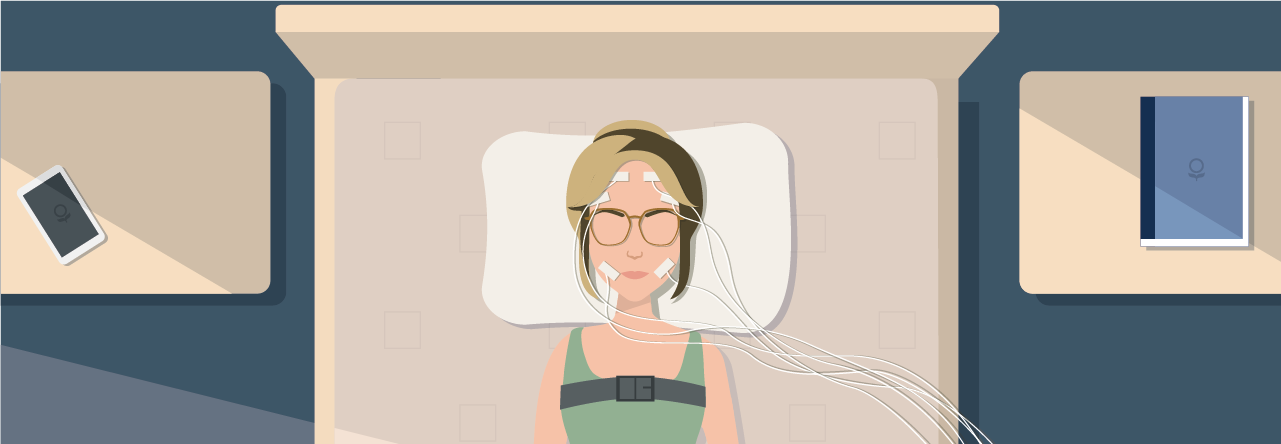
Since there’s so much to monitor while you’re asleep, getting set up for the study involves a lot of wires, electrodes, some sort of electrode goop (which I later found out is electrically conductive gel) and a book-sized electronic device that feeds the information from the wires to monitors.
On my head are probably a dozen wires for an electroencephalography (EEG) to track my brain’s electrical activity aka my brain waves, on my chest and stomach are half a dozen more for an electrocardiography (EKG) to monitor my heart, my face and legs are connected to an electromyogram (EMG) that will monitor my muscle movement and next to each of my eyes is a pair of connections to an electro-oculography (EOG) to detect eye activity. Luckily, all of the monitors I’m connected to aren’t in my room, they’re in a room down the hall. At least I won’t be kept awake by beeps all night.
All of these wires are attached to the book-sized device which has a convenient crossbody strap so I can move freely. In the bathroom, there’s also a book-sized shelf to place the device on so tragedy doesn’t befall it in the toilet, which would probably be very embarrassing and not great for the study.
In addition to the wires connected to electrodes, I also have a nasal cannula set under my nostrils to detect air movement through my mouth and nose and a respiratory inductive plethysmography (RIP) belt which tracks my breathing based on the expansion of my chest and belly. On my finger there’s also a pulse oximeter connected with an adhesive bandage to track pulse and oxygen levels. Then there’s also an audio recorder and unobtrusive camera in the room to hear and see what’s happening while I sleep without disturbing me. I can hardly notice either of them and honestly forget they are there at all most of the time.
A Sleep Tech’s Sleep Schedule
As I’m having the wires attached to me, I realize that everyone in the lab probably just recently woke up for the first part of their “day” since they work nights. I ask the sleep tech what it’s like to have a completely flipped schedule. He laughs and admits that, actually, he doesn’t sleep straight through the day, so he doesn’t miss much.
He admits that he has some of the worst sleep habits and sleep hygiene – he only sleeps a few hours at a time so that he doesn’t miss out on quality time with his daughter, who is in elementary school and hasn’t quite learned that her dad sleeps during the day. But he doesn’t mind, and he still feels well-rested sleeping a few hours at a time several times throughout the day. Meanwhile, I think to myself, I’m clocking in for sleep at 11 PM sharp every night to get my full eight hours and still wake up tired. Funny how that works out, right?
Once I’m all connected, I get a bit of time to do my bedtime routine and unwind with a book I brought with me. Even though the room is cozy and the bed is comfy, I’m still very nervous about being able to do the sleep study or fall asleep at all. So instead of winding down, I accidentally wind myself up and start doomscrolling on my phone. By the time the sleep technician comes back in to tell me in the nicest way possible that I really should go to sleep, I’m not even a little sleepy. Oops.
My Experience During the Overnight Sleep Study
It’s time for the sleep study to begin, so I turn on the sound machine, get myself nestled into the bed and, yeah, it actually doesn’t seem too bad! But I can’t go straight to sleep yet. First, we have to calibrate everything and get a baseline for my movements. Once the sleep technician returns to the monitoring room, he speaks to me through a speaker above my head. I’m told to move my eyes, open and close my mouth and move my legs. Once calibration is done, it’s time for the main event. Thanks to the wires, my head and legs are connected. If I move one, then I have to move everything at the same time, but eventually I find a comfortable position and drift off.
The first time I wake up, it’s to the sound of the sleep technician gently knocking on the door. He lets me know my leg wires got disconnected – I toss and turn in my sleep so I’m not surprised. Once they’re connected again, it’s back to dreamland. The second time I wake up, it’s to the sleep tech letting me know through the speaker that it’s 7 AM and time to wake up. The overnight study is over! But I don’t get to go home yet.
What to Expect During a Daytime Sleep Study (MSLT)
Next, is the daytime sleep study, which is the Multiple Sleep Latency Test (MSLT). This one tests how long it takes to fall asleep and what sleep stages you experience during naps. I’ve heard of people having an overnight sleep study before, but I’ve never heard of this one, and all I am told is that it involves naps. I have no idea what to expect, but I am still tired from the overnight study and waking up early.
Thankfully, to prepare for this one I get to take off some of the wires. The RIP belt, EKG wires and leg wires are removed – hooray more freedom for more movement! I still have all of the brain activity and eye movement wires though, so I’m not fully free yet. A lot happens during this sleep study, so here’s the basic schedule of events:
- Lie down in bed.
- Calibrate sensors.
- Begin nap.
- Try really, really, really hard to nap.
- Fall asleep?
- Wake up.
- Answer some questions.
- Stay awake and stay out of bed until the next nap.
- Repeat steps 1-8 four more times.
The overall goal? To see how fast I fall asleep and if I enter the rapid eye movement (REM) stage during a nap.
Staying Awake Between Nap Trials During My Sleep Study
I won’t sugarcoat it, this sleep study is definitely not something I want to do again. Each nap starts every two hours, but the length of the nap changes each time. Part of the test includes not being allowed to know how long the naps were going to be, so to me, I could have been napping for five minutes or one hour. Every time, it feels like once I fall asleep, it is time to wake up again.
Between naps I'm not allowed to be in bed or fall asleep at all. I have to do everything I can to stay awake, even though I just woke up from the middle of a great nap and there's a comfy bed in the same room with me.

To battle sleep, I end up eating a lot of snacks, reading my book, watching local news (because I can't get the TV remote to change channels) and staring longingly at the bed. The bed is an oasis, and I'm in the middle of a sleep desert.
Even though I brought a packed breakfast and lunch, the sleep technician takes pity on me and brings me plenty of snacks. (Fast forward to now: I still can’t look at a certain cheese cracker brand the same way.)
Wrapping Up: Leaving the Sleep Lab After My Study
I don't even realize that my last nap is my final nap, and I start preparing to do my routine of trying to stay awake by snacking and reading. But it's finally over. Almost a full day after arriving, I'm saying goodbye to all of my wires and going home.
It turns out that the shower in the bathroom is for people who want to wash off the electrode goop before going home. Me? I walk out of the office, and, yes, I am still very much covered in goop, and, yes, everyone can see it. I am a new person and I don't care if people see me. Soon, I will find out what's causing my sleep issues, work with my doctor to resolve them and eventually get my best sleep in years.
Life After My Sleep Study: How I’m Sleeping Today
It’s only been a few months since my sleep studies, and, though I’m not magically cured of all sleep issues, I’m slowly starting to sleep better. And now I have a new sound machine. It’s a continuous positive airway pressure (CPAP) machine and it makes the perfect amount of white noise.
Taking sleep seriously is a form of self-care and self-investment. Even if you sleep fine enough not to need a sleep study, improving sleep hygiene and maintaining a safe, healthy sleep area is essential to health. It’s possible to wake up on the right side of bed every day with the right routine and support under you. It’s also possible that even if you have all the right things, you might not be sleeping well, and if that’s true, then it’s probably time to talk to a doctor about it.
As a copywriter at Naturepedic, sleep is on my mind a lot. But even with all the sleep facts, a perfect sleep setup and healthy routine, I couldn’t solve all my sleep issues on my own. Sometimes when life gives you lemons in the form of poor sleep, you have to go get a sleep study and be humbled.